While building a basic retrieval-augmented generation (RAG) prototype takes minutes, an enterprise-grade system demands a decoupled, four-stage modular pipeline to deliver predictable, secure, and production-ready performance under strict latency SLAs
Realizing true enterprise readiness requires enforcing metadata pre-filtering, deploying explicit runtime guardrails, and establishing multi-layered telemetry to isolate and remediate system non-determinism
Building a basic retrieval-augmented generation (RAG) prototype takes minutes. Building a predictable, secure, and production-ready system requires treating retrieval as a highly engineered pipeline.
Over a capstone lab series at Ai4 recently, I built, benchmarked, and operationalized a four-stage RAG pipeline over a 200+ document legal corpus. Here is an overview of the architecture and the core engineering principles that separate production RAG from trial applications.
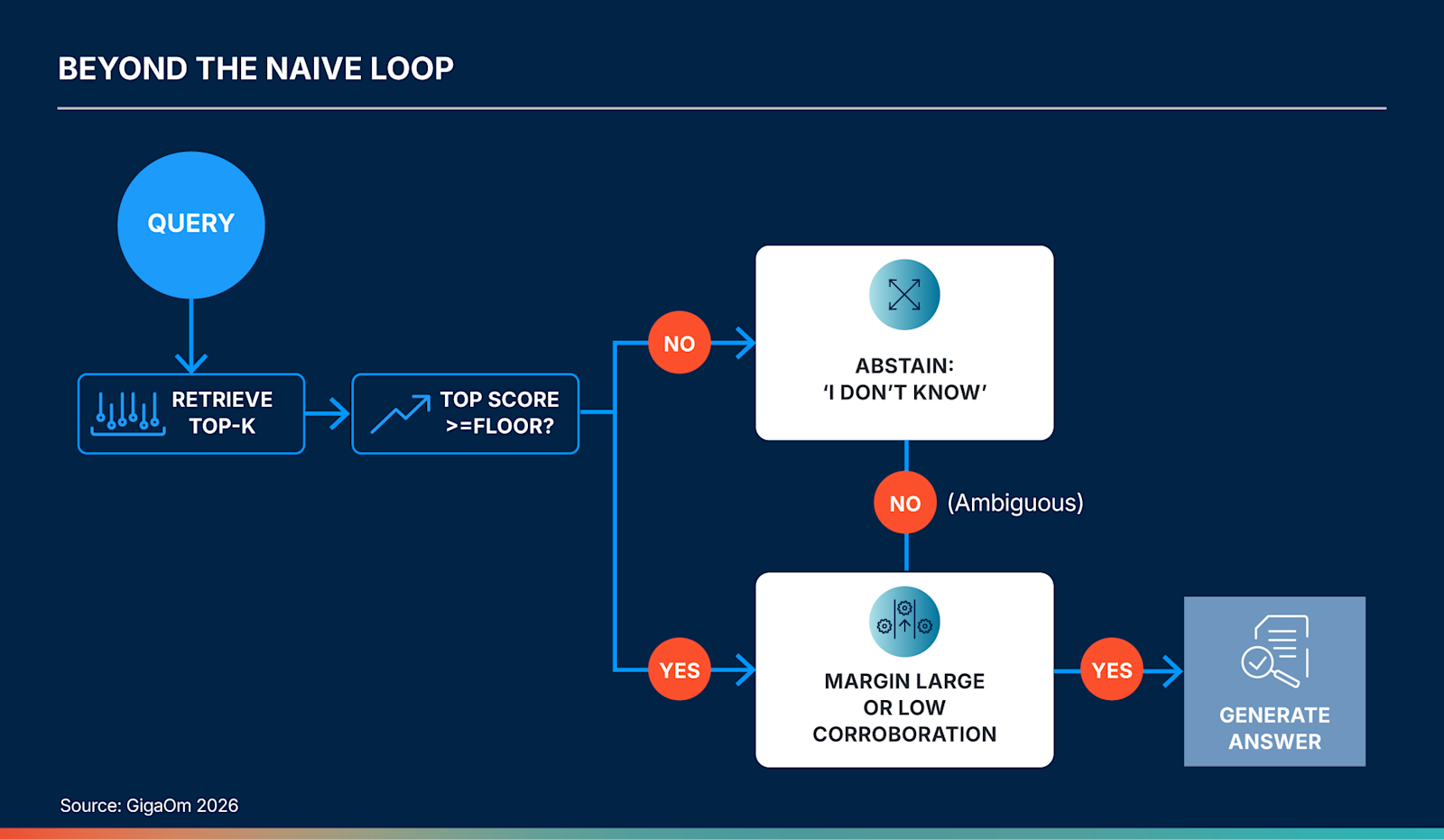
The Architecture: A Four-Stage Modular Pipeline
To deliver high retrieval precision within strict latency SLAs, the system uses four decoupled layers:
Ingestion and ingress: Heuristic query routing combined with structural, adaptive chunking (preserving code fences and Markdown tables) and content-type representations.
First-stage retrieval: Fast candidate generation using scalable FAISS vector indexing (IVF) paired with metadata pre-filtering.
Second-stage refinement: Negation-aware cross-encoder reranking and ColBERT-style late interaction to capture deep query-document semantics.
Guardrails and evaluation: Composite multitenant isolation guardrails, RAG triad evaluations, and microsecond span-level tracing.
This architecture was benchmarked across four progressive configurations against a golden dataset.
Core Architectural Takeaways
1. Stage Order Dictates Security and Latency
Order of execution is a core boundary:
Pre-filtering over post-filtering: Applying metadata pre-filtering before vector retrieval prevents cross-tenant data leaks and eliminates wasted vector comparisons on out-of-scope partitions.
Pruned reranking: Because cross-encoder reranking processes joint query-document pairs ($O(N)$ complexity), it must run as a late-stage refiner over a pruned candidate set rather than a corpus-wide scan.
Index tuning: Vector indices like FAISS IVF require tuning knobs like nprobe to balance memory footprint, search latency, and retrieval recall against strict SLAs.
2. Reranking Boosts Precision; Guardrails Prevent Hallucinations
While hybrid RRF search and cross-encoder reranking significantly increase context precision, they cannot stop LLMs from hallucinating on unanswerable queries. Only explicit runtime guardrails and hard metadata boundaries guarantee the system safely refuses out-of-scope prompts.
3. Operationalizing RAG Demands Granular Observability
Maintaining production quality requires specialized telemetry:
Unpack the RAG triad: Tracking context relevance, groundedness, and answer relevance as three separate diagnostic metrics isolates whether issues stem from retrieval, context loading, or prompting.
Stabilize LLM evaluators: Multi-run averaging is mandatory to offset non-determinism when using LLM-as-a-judge for CI/CD regression testing.
Span-level tracing: Detailed tracing pinpoints whether latency spikes originate from vector search, cross-encoder inference, or model generation.
What AI Engineers and Architects Should Do Now
Enforce pre-filtering: Immediately audit your vector retrieval pipelines to ensure metadata boundaries are established prior to index scanning.
Deploy explicit guardrails: Implement hard runtime guardrails to manage unanswerable or out-of-scope prompts rather than relying on downstream model intelligence.
Standardize the RAG triad: Integrate isolated metrics for context relevance, groundedness, and answer relevance into your automated testing frameworks, utilizing multi-run averaging to counter judge non-determinism.
Final Thoughts
The primary challenge in modern AI engineering isn't model generation—it's building deterministic, secure, and observable infrastructure around the model.
For additional insight and solutions, see:
GigaOm Radar for Vector Databases
GigaOm Radar for Data Access Governance
GigaOm Radar for Data Observability
William McKnight is an analyst for GigaOm Research who takes corporate information and turns it into a bottom-line-enhancing asset. He is a former Fortune 50 technology executive and database engineer, an Ernst & Young Entrepreneur of the Year finalist and frequent best practices judge. He helps clients in the financial, healthcare, pharmaceuticals, and telecommunications industries with action plans, architectures, strategies, and technology tools to manage information. Click here to connect with William or schedule a strategy session.