Security policy as code turns an organization's existing rules for access, configuration, and compliance into versioned, testable artifacts that a machine enforces when something changes. While the practice began as a pipeline check, products today enforce policy at pull request, build, and Kubernetes admission, and also inside cloud control planes, on network edges, in application authorization calls, and around the tool calls of AI agents.
That reach changes the purchase: buyers now choose an enforcement point and an operating model before they choose a language. Because the same layer carries operational enforcement, engineering workflow, and the evidence regulators ask for, the CIO, CTO, and CISO all must agree before a decision holds.
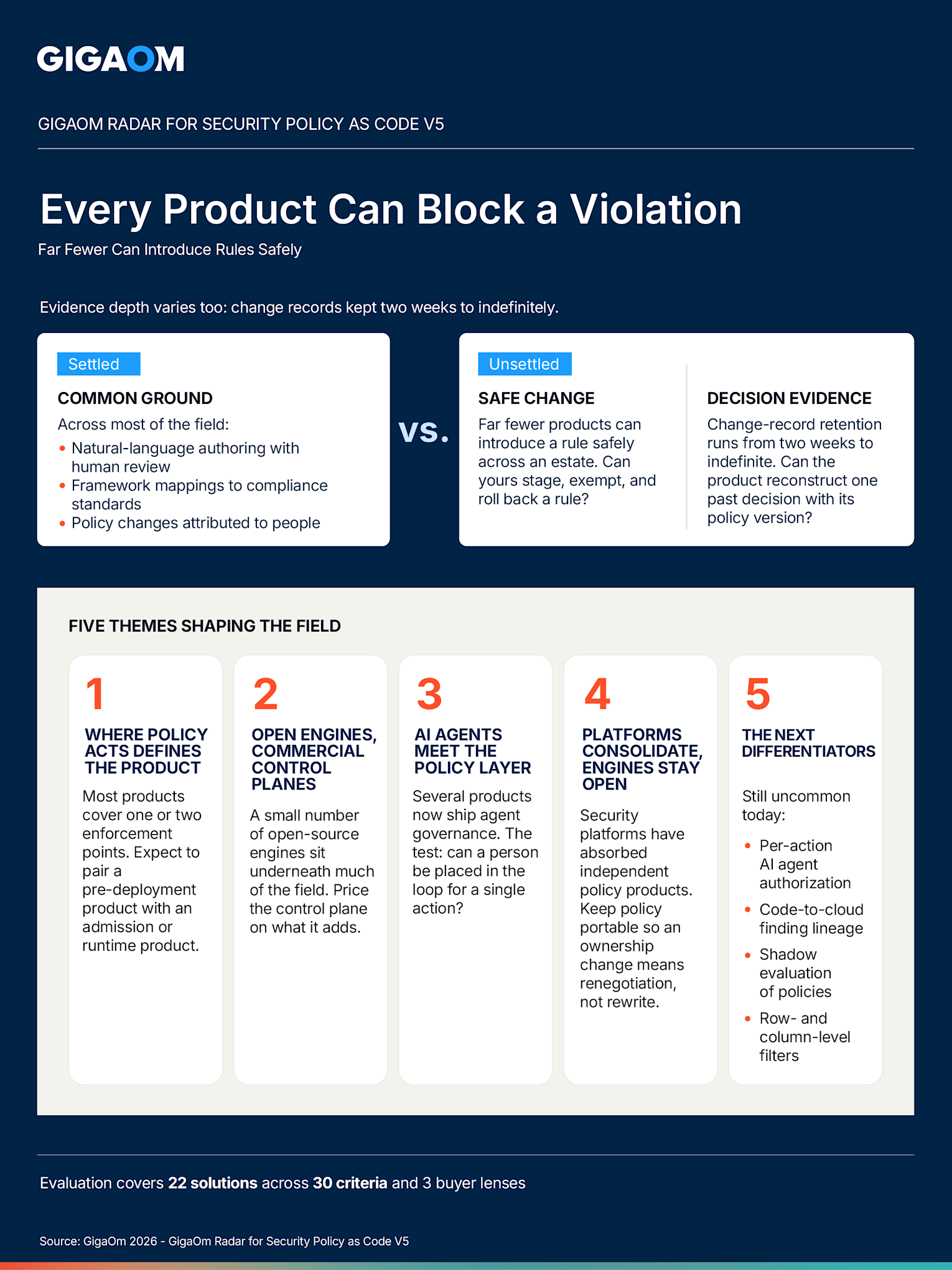
The 2026 GigaOm Radar for Security Policy as Code evaluates 22 solutions against 30 decision criteria, including six emerging technologies, mapped to the Tech Buying Triad of the CIO, CTO, and CISO. Five themes show where the field separates.
1. Where Does Security Policy as Code Get Enforced?
Usually at one or two points per product.
Some products evaluate infrastructure code at merge and build. Others hold policy inside clusters and hosts through admission controllers and agents, evaluate every request inline on a global network or in a cloud provider's resource manager, or answer an authorization call from application code with obligations and data filters. A few platforms govern several of these points from one tenant, and a product's strengths follow its enforcement point rather than its feature list.
Buyers should map every point at which a bad change could reach production, from pull request to running session, and expect to pair a pre-deployment product with an admission or runtime product.
2. What Engine Sits Underneath a Policy as Code Product?
Often, an open-source one.
A small number of open-source engines sit underneath much of the field, including a general-purpose engine with a declarative language, a Kubernetes-native engine that powers admission control, and an open runtime detection engine. In these cases, the commercial product is the control plane around the engine: fleet distribution, exceptions, compliance reporting, and audit. Two products can share an engine while differing entirely in what they add.
Buyers should identify the engine beneath each product, confirm the project's license and governance, and price the control plane on what it adds.
3. Can a New Policy Be Rolled Out Without Disrupting Production?
In far fewer products than can block a violation.
The stronger platforms pin environments to immutable policy versions, promote a change by group, run a candidate rule in audit or shadow mode against live traffic, and roll back by reassigning a version. Exceptions go to named approvers, have an expiry, and return the target to enforcement when they lapse. Elsewhere, switching a rule between reporting and blocking is a single toggle with no staging, and exceptions are notes without a date.
Buyers should rehearse a change before signing: introduce a new blocking rule to one environment, grant a time-bound exception, promote the rule to production, and roll it back.
4. Can Policy as Code Govern AI Agents?
Several products now ship that capability, in different shapes.
Some authorize each model and tool call at a gateway on a default-deny basis and hold high-risk actions for a named approver. Some extend network and access grants to models and connectors under the same identity model as people and workloads, and others inspect generative AI prompts and responses or gate model releases through pipeline policy. Natural-language authoring is now common, and in a few products the generated policy arrives with executable tests.
The distinguishing question is whether a person can be placed in the loop for a single action. Buyers should ask each vendor to demonstrate a hold on one tool call and treat generated policy as untrusted until it carries tests.
5. How Much Audit Evidence Does Policy as Code Keep?
It varies widely, even where compliance claims look alike.
Framework mappings appear across the field, and most products attribute policy changes to a person. But retention of change records runs from two weeks to indefinite history. Some products keep every decision with the deciding policy, scope, and version; some keep violations but not the requests they rejected; and some keep no per-request record of a passing decision at all. Residency ranges from air-gapped operation to global services with no regional choice.
Buyers should ask for the record of one specific past decision, including the policy version that made it, and confirm retention periods in writing.
What Comes Next for Policy as Code?
GigaOm finds that several capabilities that once separated vendors are already close to assumed, including native pull-request checks that block only the violations a change introduces, Kubernetes admission control, framework mappings to common compliance standards, and attributed change logs. Exceptions that carry an owner and an expiry date, staged rollout from audit to blocking, and infrastructure-automation providers for the policy configuration itself are following the same path.
The next separation is visible in capabilities that are not yet widespread. Per-action authorization of AI agents exists in a small number of products; shadow evaluation of a candidate policy against recorded requests and authorization that returns row and column filters to a database query remain rare; and code-to-cloud lineage that opens the fix as a pull request appears in a minority. Meanwhile, the market is consolidating at the platform layer while staying open at the engine layer, so buyers should favor contracts and architectures that keep policy portable on an open engine, making a change of owner a renegotiation rather than a rewrite.
Frequently Asked Questions
What is security policy as code?
Security policy as code turns an organization's rules about access, configuration, and compliance into versioned, testable artifacts that a machine enforces at the moment something changes. Enforcement points include pull requests, Kubernetes admission, cloud control planes, and AI agent tool calls.
How many solutions does the GigaOm Radar for Security Policy as Code evaluate?
The 2026 GigaOm Radar for Security Policy as Code evaluates 22 solutions against 30 decision criteria, including six emerging technologies, mapped to the Tech Buying Triad of the CIO, CTO, and CISO.
What should buyers test before shortlisting a policy as code product?
GigaOm recommends pressure-testing four things, in order, before shortlisting: which enforcement points the product governs itself; whether enforcement continues on cached policy, fails open, or fails closed when the control plane is disconnected, and who chose that setting; a full rollout, exception, and rollback rehearsal; and the reconstruction of one past decision from the audit record.
Which policy as code capabilities are becoming standard?
Native pull-request checks that block only newly introduced violations, Kubernetes admission control, framework mappings to common compliance standards, and attributed change logs already appear across most of the field, according to GigaOm. The report expects that within two years, a product lacking capabilities like these will be a specialist tool rather than a general platform.
Read the Full Report
The full GigaOm Radar for Security Policy as Code includes vendor capsules for all 22 solutions, a decision matrix that matches buyer profiles to the right part of the market, and an Architect's Validation section on the deployment-specific questions that decide outcomes in this category. Read the full report.