Insights from the Inside Out
Every AI vendor tells you that you need to get your data house in order before you can use AI. Meanwhile, every AI enthusiast tells you to just throw your data at the model and let AI figure it out.
They're both wrong.
I've watched both failure modes play out dozens of times. The companies that try to boil the ocean—fixing all their data before touching AI—never finish. The companies that fling garbage at models hoping diamonds will emerge—well, that's neither how garbage nor diamonds work.
The answer is neither. And it's not a compromise between two bad ideas. It's a fundamentally different approach.
WHAT THIS MEANS FOR THE CIO/CTO/CISO
Neither extreme works: comprehensive data transformation takes forever, and "let AI figure it out" produces garbage. You need a third path that responds to business needs while building enterprise intelligence.
Data quality investment must be use-case-driven and feedback-rich. Fix what matters for the immediate need, but capture what you learn so the enterprise can make informed investment decisions.
Your data quality work should generate business intelligence, not just clean data. Every focused effort should tell you something about the broader data estate that informs future decisions.
THE INSIDE PERSPECTIVE
When I was in the chair, I watched data quality initiatives fail in two completely different ways.
The first failure mode was paralysis. Someone would present the vision: unified data governance, consistent quality standards, enterprise-wide cleansing. Two years and millions of dollars later, we'd have a fraction of the scope complete. The business had lost patience. AI was still "coming soon."
The second failure mode was chaos. Someone would declare that AI could handle messy data—just throw everything at the model and let machine learning sort it out. We'd dump terabytes into a pipeline, hit run, and watch the hijinks ensue. Hallucinations. Contradictions. Confident wrong answers. Results so unreliable that no one would trust the output.
Both failures had the same root cause: disconnection from business reality.
The initiatives that actually worked were different. They started with a business question, fixed the data needed to answer that question, learned something in the process, and fed that learning back to inform broader decisions.
THE OUTSIDE OBSERVATION
Now I watch the same two failure modes play out at scale across the industry.
On one side: massive data governance programs that become permanent overhead. Armies of consultants building frameworks. Data quality scores improving while AI initiatives stall. The perfect becoming the enemy of the good.
On the other side: the "we'll do it live" crowd. Enterprises dumping raw data into AI pipelines with no quality consideration whatsoever. Treating hallucinations as a model problem instead of a data problem. Wondering why their AI produces garbage while insisting the technology is at fault.
The analysts covering this space tend to pick a side. Some advocate for comprehensive data transformation. Others hype AI's ability to find signal in noise. Neither approach works in practice.
The organizations actually getting value from AI are doing something different—something that neither the governance vendors nor the AI enthusiasts want to talk about.
THE UNCOMFORTABLE TRUTH
Both failure modes stem from the same misconception: that data quality is a technical problem with a technical solution.
It's not. Data quality is a business problem that requires business judgment about where to invest.
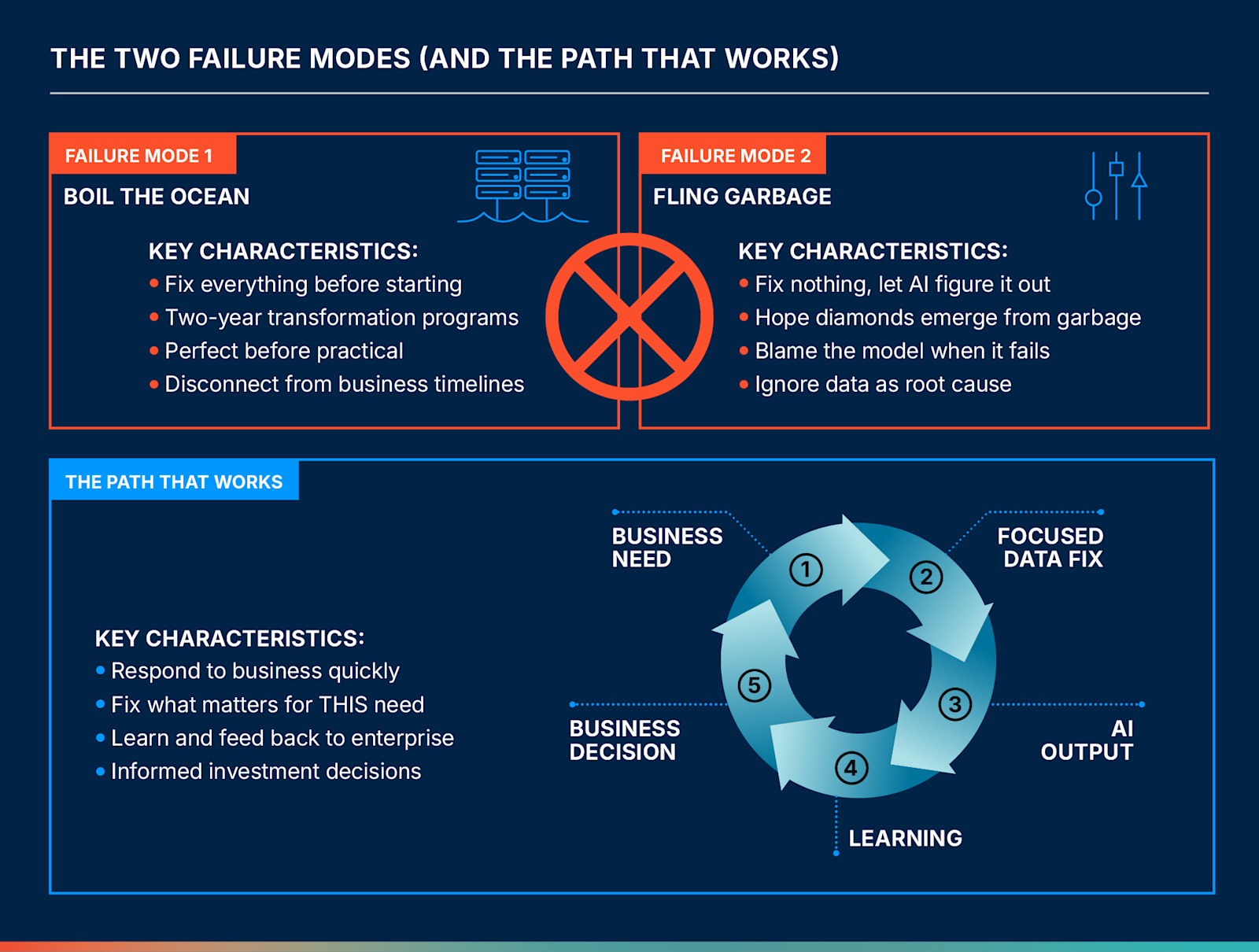
Failure Mode 1: Boil the Ocean
The enterprise commits to comprehensive data transformation before AI deployment. Years pass. Budgets drain. The business moves on. By the time the data is "ready," the opportunity has passed and the technology has changed.
The fundamental error: treating data quality as a destination instead of a continuous process.
Failure Mode 2: Fling Garbage
The enterprise dumps raw data into AI pipelines, hoping the model will find the signal in the noise. Outputs are inconsistent, unreliable, and often wrong. Users lose trust. The AI initiative is labeled a failure.
The fundamental error: treating AI as magic that can compensate for any input quality.
Both modes share the same problem: they disconnect data quality decisions from business value. One over-invests without feedback. The other under-invests without consequences.
THE GARBAGE-IN REALITY
Let me be specific about what happens when you fling garbage at AI.
LLMs work by finding the mean in noise. Feed them enough data, and patterns emerge. This works for general knowledge because the corpus is massive—errors average out.
It does not work for enterprise data.
Your enterprise data isn't a massive corpus. It's a specific, limited dataset with specific, concentrated problems. When you feed bad data to AI, you don't get "mostly right with some noise." You get confidently wrong answers that look exactly like right answers.
Duplicate customer records don't average out—they double-count revenue and make every analysis wrong.
Inconsistent date formats don't self-correct—they create phantom patterns and temporal hallucinations.
Contradictory source systems don't resolve themselves—AI picks one arbitrarily and presents it as fact.
Missing data doesn't fill itself in—AI either ignores it (skewing results) or invents it (hallucinating facts).
The "let AI figure it out" crowd acts like machine learning is magic. It's not. It's math. And math applied to garbage produces garbage—just faster and with more confidence.
THE THIRD PATH: RESPONSIVE AND INFORMATIVE
The approach that actually works is neither extreme. It's responsive to business needs AND it generates intelligence for enterprise decisions.
Here's the principle: Respond to the business quickly. Fix data quality where it matters for THIS need. Learn what you find. Feed that learning back to the enterprise to inform investment decisions.
This isn't a compromise between two bad ideas. It's a fundamentally different operating model.
Stage 1: Business Need Emerges A specific question or use case surfaces with real business value. Not theoretical value. Real value that someone will pay for or act on.
Stage 2: Assess Required Data What data sources does this need require? What's their current quality state? What specific issues would prevent AI from delivering reliable results?
Stage 3: Targeted Quality Fix Fix what matters for THIS use case. Nothing more. Be ruthless about scope. The goal is enabling this specific outcome, not perfecting the data estate.
Stage 4: Deploy and Validate Get AI working on the fixed data. Measure actual outcomes. Is it reliable? Is it trusted? Is it delivering the business value we expected?
Stage 5: Capture and Report Here's where most approaches fail. Document what you found. What quality issues existed? What did it cost to fix them? What would broader fixes across similar data enable? What's the estimated ROI of expanding this work?
Feed this intelligence back to the enterprise. Let business leaders decide where to invest based on demonstrated value and identified opportunities—not based on abstract governance frameworks or wishful thinking about AI magic.
THE INTELLIGENCE FEEDBACK LOOP
Every focused data quality effort should make the enterprise smarter about its data.
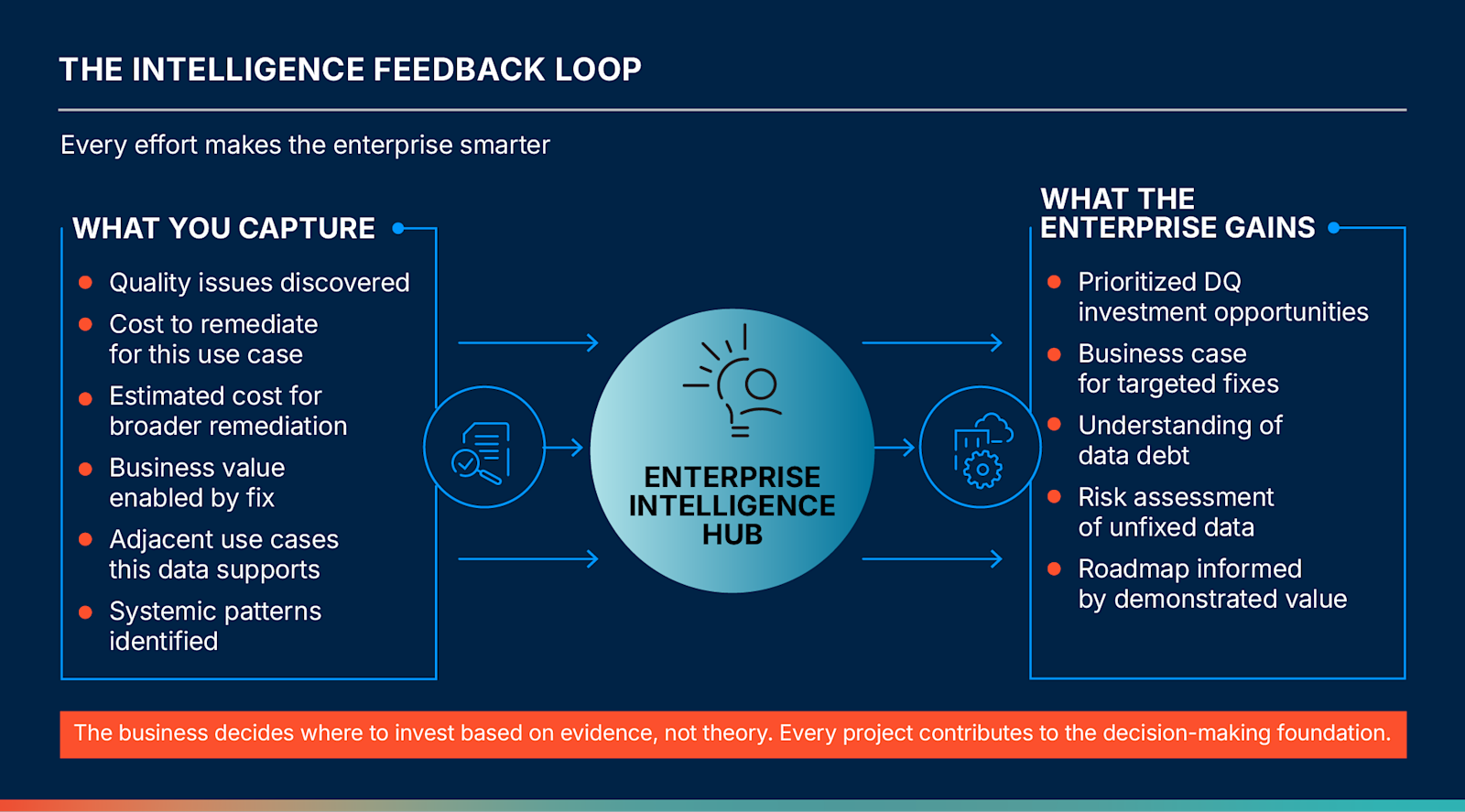
What you capture from every focused effort:
Quality issues discovered (what was wrong?)
Cost to remediate for this use case (what did it take to fix?)
Estimated cost for broader remediation (what would it cost to fix everywhere?)
Business value enabled (what did fixing it unlock?)
Adjacent use cases this data supports (what else could benefit?)
Systemic patterns identified (is this a one-off or a symptom of broader issues?)
What the enterprise gains:
Prioritized investment opportunities based on demonstrated value
Business cases for targeted fixes backed by real numbers
Understanding of data debt and its actual cost
Risk assessment of leaving data unfixed
A roadmap informed by evidence, not governance theory
This is how you build organizational intelligence about data quality. Not through comprehensive assessments that never end. Not through ignoring the problem and hoping AI compensates. Through systematic learning from targeted work.
SIGNS YOUR APPROACH IS FAILING
Use this diagnostic to identify which failure mode you're in:
Signs You're Boiling the Ocean:
☐ 12+ months without enabling a single AI use case
☐ Data quality scores improving while AI initiatives stall
☐ More governance overhead than actual data cleaning
☐ Business stakeholders stopped asking about AI timelines
☐ Team talks about "phase one" and "foundation" constantly
Signs You're Flinging Garbage:
☐ AI outputs are inconsistent or unreliable
☐ Users don't trust AI recommendations
☐ Hallucinations blamed on "model limitations"
☐ No one can explain why AI produces wrong answers
☐ Data quality dismissed as someone else's problem
Signs You're On the Right Path:
☐ AI value delivered within 90 days of business need
☐ Each project generates enterprise intelligence about data
☐ Business priorities drive data quality investment
☐ Investment decisions based on demonstrated ROI
☐ Cumulative learning informs broader strategy
THE TRUST EQUATION
The real goal isn't data quality. It's not AI deployment. It's trust.
How do you get your organization to trust AI enough to act on it?
You don't get there by promising comprehensive data transformation that takes years. You don't get there by deploying AI on garbage and hoping no one notices the errors.
You get there by demonstrating reliability. One use case at a time. With honest feedback about what it took and what it enabled.
Trust builds through demonstrated reliability.
One reliable AI use case teaches more than a hundred governance documents. When people see AI work correctly, consistently, on something that matters to them, they start to believe.
Trust builds through honest accounting.
When you tell stakeholders "this AI works because we fixed these three data issues, and here's what it cost," you build credibility. They understand the relationship between investment and outcome. They can make informed decisions about the next investment.
Trust builds through cumulative learning.
Each project adds to enterprise intelligence. Over time, the organization develops a realistic understanding of its data quality challenges and the investment required to address them. That understanding enables strategic decisions instead of reactive firefighting.
WHAT I'D TELL MY FORMER SELF
If I had known then what I know now:
I would reject both extremes immediately. Neither "fix everything first" nor "let AI figure it out" has ever worked. Stop pretending they will.
I would require every data quality effort to generate enterprise intelligence. Not just clean data—insight into the data estate that informs future decisions.
I would measure success by trust built, not data cleaned. Does the business trust AI more after this project? That's the only metric that matters.
I would create a feedback mechanism from day one. Every project reports: what was wrong, what it cost to fix, what it enabled, what broader fixes would enable. The enterprise uses this to prioritize.
I would stop treating data quality as IT's problem. It's a business investment decision. IT provides the intelligence. The business decides where to invest.
THE ARCHITECTURE VIEW
Boil the Ocean Architecture:
All data sources → Comprehensive governance → Massive transformation → Eventually AI
Timeline: 24+ months before value
Problem: Never finishes, disconnected from business needs
Fling Garbage Architecture:
All data sources → Dump directly into AI → Hope for the best
Timeline: Fast, but produces garbage
Problem: Unreliable outputs destroy trust
Responsive and Informative Architecture:
Business need → Targeted data sources → Focused quality fixes → AI deployment → Feedback to enterprise
Timeline: 90 days to first value, cumulative learning
Advantage: Responds to business, generates intelligence, enables informed investment
THE PLAYBOOK FOR RESPONSIVE DATA QUALITY
Five steps to implement responsive, intelligence-generating data quality:
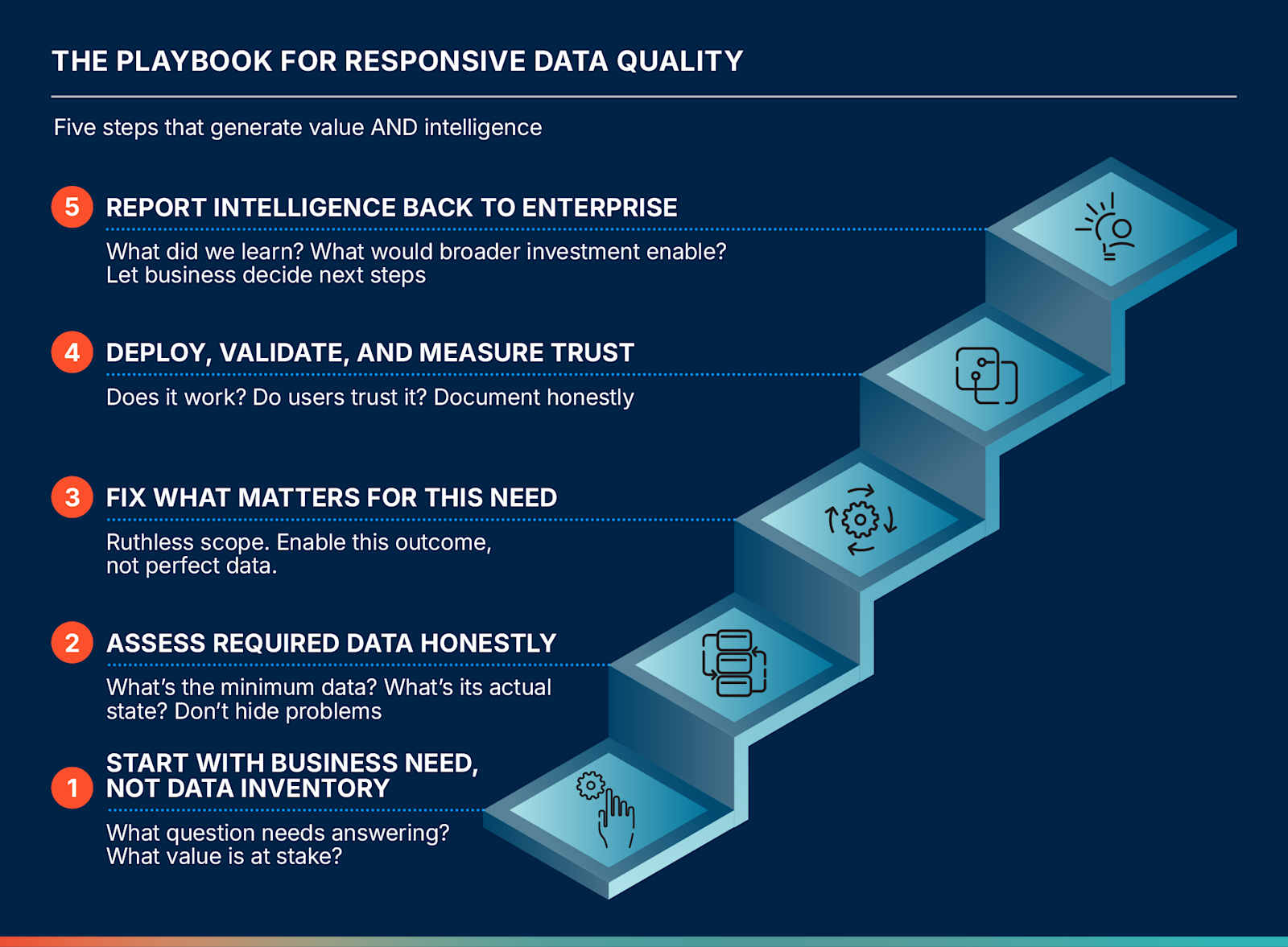
Start with business need, not data inventory. What question needs answering? What business value is at stake? If there's no clear business need, there's no project. Don't clean data speculatively.
Assess required data honestly. What's the minimum data needed? What's its actual quality state? Be honest about problems—hiding them just delays the reckoning. Document what you find.
Fix what matters for THIS need. Ruthless scope. Enable this specific outcome, not theoretical future outcomes. Every fix should be traceable to the use case it enables.
Deploy, validate, and measure trust. Get AI working. Measure whether it's reliable. Ask users whether they trust it. Document both the successes and the remaining issues.
Report intelligence back to enterprise. What quality issues did you find? What did it cost to fix them? What would broader fixes enable? What adjacent use cases are now visible? Give the business the information it needs to decide where to invest next.
THE INTELLIGENCE REPORT
Every project should produce an intelligence report for enterprise decision-makers:
Use Case Delivered:
Business question answered
Value delivered (quantified where possible)
Trust level achieved (do users rely on it?)
Data Quality Findings:
Specific issues discovered
Root causes identified
Assessment: systemic problem or isolated issue?
Investment Made:
Cost to remediate for this use case
Time required
Resources used
Opportunity Identified:
Estimated cost for broader remediation
Additional use cases this would enable
Business value of expansion
Recommended priority (high/medium/low)
Decision Requested:
Should we invest in broader remediation?
What's the next highest-value use case?
What data work should we prioritize?
This is how you turn tactical data quality work into strategic enterprise intelligence. Every project contributes to smarter decisions.
KPIS TO MEASURE THE RIGHT APPROACH
| KPI | Target | What It Measures |
|---|---|---|
| Time to Business Value | < 90 days | Responsiveness to business needs |
| Trust Score per Use Case | Users rate 4+/5 | Whether AI is actually trusted and used |
| Intelligence Reports Generated | 100% of projects | Feedback loop functioning |
| Investment Decisions Informed | Action within 60 days | Enterprise using the intelligence |
| Cumulative Learning Utilization | Projects reference prior findings | Organizational intelligence building |
If you're not measuring both delivery AND intelligence generation, you're missing half the value.
INTERNAL CONVERSATIONS
What to tell your CFO when they ask about data quality strategy:
"Neither extreme works. Boiling the ocean wastes millions. Flinging garbage destroys value. We're doing something different."
"Our approach delivers AI value in 90 days AND generates intelligence for investment decisions. Every project informs where to put the next dollar."
"We're not asking for a massive data transformation budget. We're asking for permission to fix what matters, learn from it, and report back what broader investments would enable."
What to tell your Board when they ask about data readiness:
"We're not waiting for perfect data, and we're not hoping AI will magically compensate. We're responding to business needs quickly and learning from each engagement."
"Every project generates intelligence about our data estate. The business decides where to invest based on demonstrated value, not theoretical frameworks."
"Trust builds through reliable delivery, not promised transformation. We're building trust one win at a time."
What to tell your Data Team when they're stuck between extremes:
"Stop trying to fix everything. Stop accepting garbage. Do something in between that's actually useful."
"Your job is enabling specific business outcomes AND generating intelligence for enterprise decisions. Both. Every project."
"Every time you touch data, you should make the enterprise smarter about that data. Document what you find. Report what broader fixes would enable."
What to tell your AI Team when they blame data for failures:
"AI is not magic. It cannot compensate for garbage data. Stop pretending it can."
"Partner with data teams on targeted fixes for specific use cases. Help identify what quality issues actually impact outcomes."
"When AI fails, help document why. That intelligence helps the enterprise decide where to invest in data quality."
TO DATA LEADERS
Your job isn't to have clean data. Your job isn't to deploy AI. Your job is to help the enterprise make smart decisions about data investment.
That means: respond to business needs quickly. Fix what matters for each need. Generate intelligence about what you find. Feed that intelligence back so the enterprise can decide where to invest.
Stop being the department that says "wait until we fix everything." Stop being the department that says "just throw it at AI." Be the department that enables business value and builds organizational intelligence.
TO AI TEAMS
Your models aren't magic. They cannot compensate for garbage data.
When you deploy on bad data and get bad results, the organization loses trust in AI—not in the data. You're not doing yourself any favors by pretending data quality doesn't matter.
Partner with data teams. Identify the quality issues that actually impact your outcomes. Help document what fixing them would enable. Be honest about what AI can and cannot compensate for.
TO EXECUTIVES
Data quality is not a technical problem. It's a business investment decision.
Your role is to demand the intelligence needed to make that decision. Every project should report: what quality issues exist, what it cost to fix them for this use case, what broader fixes would enable, and what the estimated ROI of that investment would be.
Then decide. Where do you invest? What do you accept? What risk do you carry?
That's a business decision, not an IT decision. But you can only make it if IT provides the intelligence.
A NOTE ON ANALYST CULTURE
Most analyst coverage picks a side on data quality.
Governance-focused analysts say fix your data before deploying AI. AI-focused analysts say modern models can handle messy data. Both are selling something.
Neither approach works in practice. The comprehensive approach never finishes. The "AI will figure it out" approach produces unreliable garbage.
The approach that works—responsive, intelligence-generating, business-informed—doesn't fit neatly into either camp. It doesn't sell governance platforms. It doesn't hype AI magic. It just works.
GigaOm advocates for what works, even when it doesn't fit the vendor narratives on either side.
ONE-PAGE SUMMARY
THE PREDICTION: Organizations escape both failure modes in 2026—comprehensive transformation that never finishes AND garbage-in-garbage-out chaos. Winners respond to business needs quickly while generating intelligence that enables smart enterprise investment decisions.
THE TWO FAILURE MODES:
Boiling the Ocean: Years to value, massive cost, disconnected from business, never finishes
Flinging Garbage: Fast but unreliable, destroys trust, confidently wrong, blamed on AI
THE THIRD PATH:
Respond to business needs within 90 days
Fix what matters for each specific use case
Generate intelligence about the broader data state
Enterprise decides investment based on demonstrated value and identified opportunity
THE PLAYBOOK:
Start with business need, not data inventory
Assess required data honestly—don't hide problems
Fix what matters for THIS need, ruthless scope
Deploy, validate, and measure trust
Report intelligence back to enterprise for investment decisions
KPI'S TO TRACK:
Time to Business Value (target: < 90 days)
Trust Score per Use Case (target: 4+/5 user rating)
Intelligence Reports Generated (target: 100% of projects)
Investment Decisions Informed (target: action within 60 days)
Cumulative Learning Utilization (target: projects reference prior findings)
THE BOTTOM LINE: Don't boil the ocean—it never finishes. Don't fling garbage—it destroys trust. Respond quickly. Learn constantly. Feed intelligence back to the enterprise. Let the business decide where to invest based on evidence, not theory.
Howard is CEO of GigaOm, bringing 38 years in IT and 20 years at the C-level as CISO, CIO, and CTO to technology analysis. His "Inside Out" series combines practitioner experience with analyst perspective to challenge industry narratives and provide actionable guidance for technology leaders.