Insights from the Inside Out
Every HR department is scrambling to figure out how to evaluate employees in an AI world. They're building competency frameworks. They're creating certification programs. They're measuring prompt quality and output volume.
They're overcomplicating it.
After 20 years leading technology teams, I can tell you the only metric that matters: curiosity.
WHAT THIS MEANS FOR THE CIO/CTO/CISO
Your AI competency assessments are measuring the wrong things. Certifications, prompt libraries, and output metrics miss the fundamental differentiator.
The employees who will thrive aren't the ones who use AI the most—they're the ones who understand it most deeply. Usage is easy. Comprehension is rare.
Your competitive advantage in AI isn't technology—it's the curious people who know how to partner with it. You can buy the same tools as everyone else. You can't buy curiosity.
THE INSIDE PERSPECTIVE
When I built teams, the employees who thrived weren't the ones with the best credentials or the most experience. They were the ones who asked "why" and "what if" constantly. They were relentlessly curious.
I hired plenty of people with impressive resumes who turned out to be mediocre performers. They knew what they knew, and that was the end of it. When something new emerged, they waited to be trained. When something broke, they waited to be told how to fix it. They were competent within their boundaries and useless outside them.
The curious ones were different. They'd dig into problems nobody asked them to solve. They'd experiment on their own time. They'd come to me with ideas that started with "I was wondering why..." and ended with "so I tried this and here's what I found."
Those people were worth ten of the credentialed-but-incurious. They're the ones who built things that mattered. They're the ones who figured out how to make technology actually work instead of just following the manual.
THE OUTSIDE OBSERVATION
Now I watch companies try to measure AI competency with frameworks designed for a different era.
They're counting certifications. They're measuring prompt volume. They're tracking output quantity. They're building elaborate rubrics that evaluate everything except the thing that matters.
The result is predictable: organizations full of people who can use AI tools but can't make them work. Who can write prompts but can't solve problems. Who can generate output but can't generate value.
Meanwhile, the curious employees—the ones who actually understand what's happening under the hood—are being evaluated by the same metrics as everyone else. Their deep comprehension counts the same as someone else's superficial usage.
The measurement systems are optimizing for the wrong thing. And you get what you measure.
THE UNCOMFORTABLE TRUTH
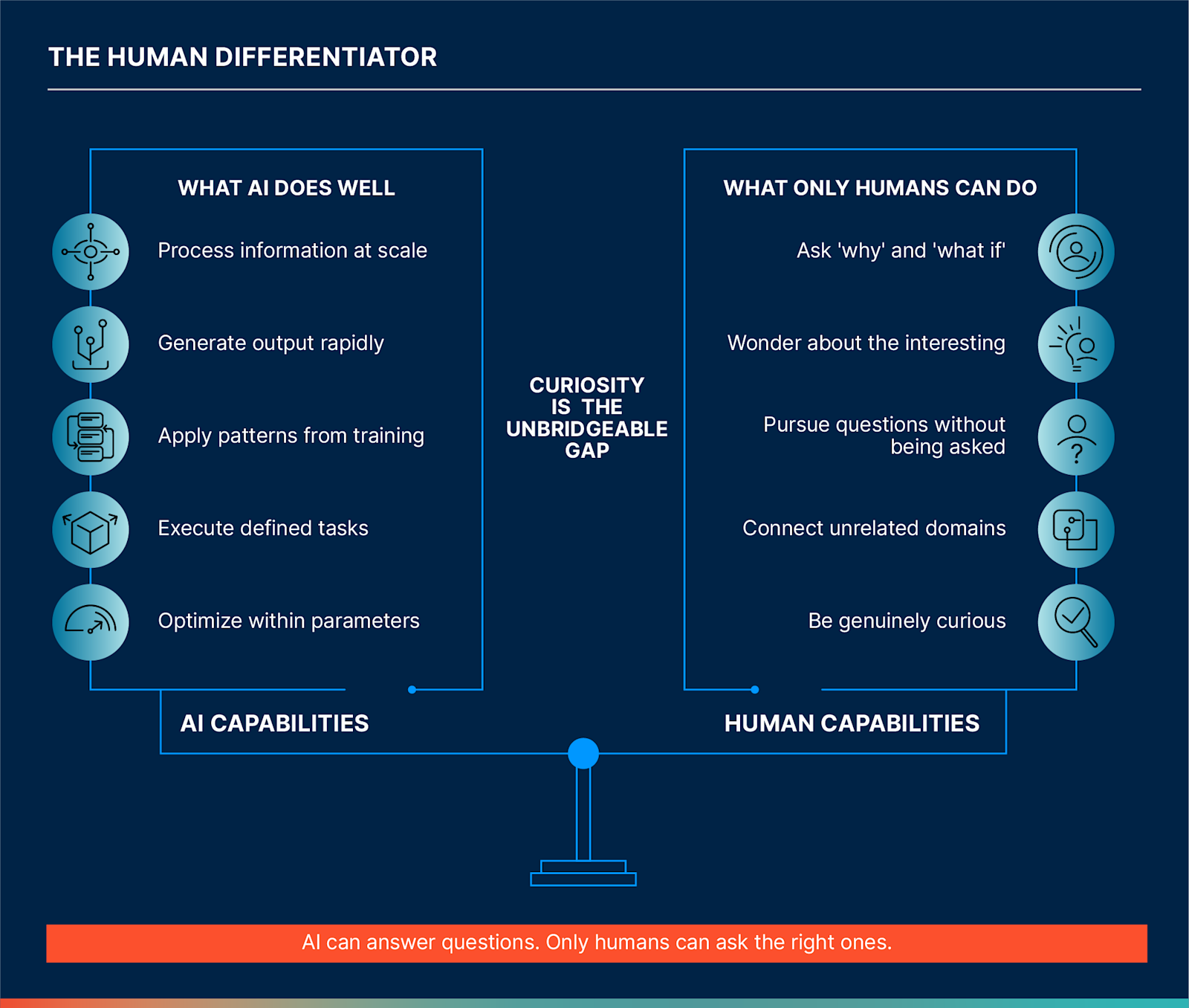
Machines aren't curious.
AI is a wonderful, amazing, brilliant machine. It knows the corpus of human knowledge in theory. It can process information faster than any human. It can generate output at scale that would take humans years.
But it isn't curious. It can't ask "what if we tried something completely different?" It can't wonder why something works the way it does. It can't pursue a question simply because the question is interesting.
Humans can do all of those things. The best humans are infinitely curious. They can't help but ask questions, explore possibilities, and dig deeper than they need to.
That's the differentiator. That's what makes humans valuable in an AI world.
Not the ability to prompt. Not the ability to use tools. Not the ability to generate output. The ability to be curious—to ask questions that machines would never think to ask.
THE PRODUCTIVITY PARADOX
AI is the biggest productivity enhancement in my 38-year career. Nothing comes close.
But you don't get that out of the box.
I've watched employees treat GenAI as deceptively simple. They type prompts. They get output. They assume that's all there is to it. The output is mediocre, but they don't know enough to recognize it's mediocre. They blame the tool when the results disappoint.
Those employees are making themselves replaceable. If all you can do is type prompts and accept output, you're competing with everyone else who can type prompts and accept output. That's a race to the bottom.
The employees who get exceptional results are the ones who invested time in understanding. They learned how the models work. They experimented with different approaches. They built context over time. They treated AI as a partnership to be developed, not a tool to be used.
The difference between my AI output quality and someone else's isn't in the prompt. It's in how much I've invested in getting the AI to understand the problem at its root. When I ask a question, the AI has the right foundation to provide the right answer. It doesn't provide AI slop. It provides quality output.
That investment is curiosity in action. Curious people can't help but dig deeper. Incurious people stop at the surface.
THE COMPLEXITY HIDING IN PLAIN SIGHT
There is no piece of AI that is not far more complex than any solution that came before it.
The problem with AI is it makes things seem easy. It's the easiest thing to interface with. It's the easiest thing to get output from. Type a sentence, get a response. What could be simpler?
Everything about that ease is a trap.
If you want quality—if you really want to solve problems, if you really want to not make mistakes—all of that ease hides enormous complexity. The people who treat AI as simple will get simple results. The people who recognize the complexity and invest in understanding it will get results that actually matter.
This is the same conversation we had about data quality and SLMs. If all you want is the easy answer, I'm sorry—this is too complex. You're going to be disappointed.
Smart companies are going to show they understand that complexity. They're going to demonstrate they can navigate it. And they're going to win because their competitors treated complexity as someone else's problem.
WHAT LEADERS MUST DO
Identify the curious people in your organization and enable them to work with AI.
This isn't complicated. You already know who they are. They're the ones who ask questions in meetings that make everyone think. They're the ones who experiment without being told to. They're the ones who come back with "I tried something and here's what I learned."
Give them skunkworks projects. See what they come up with.
But here's the hard part: you have to be ready for what comes next.
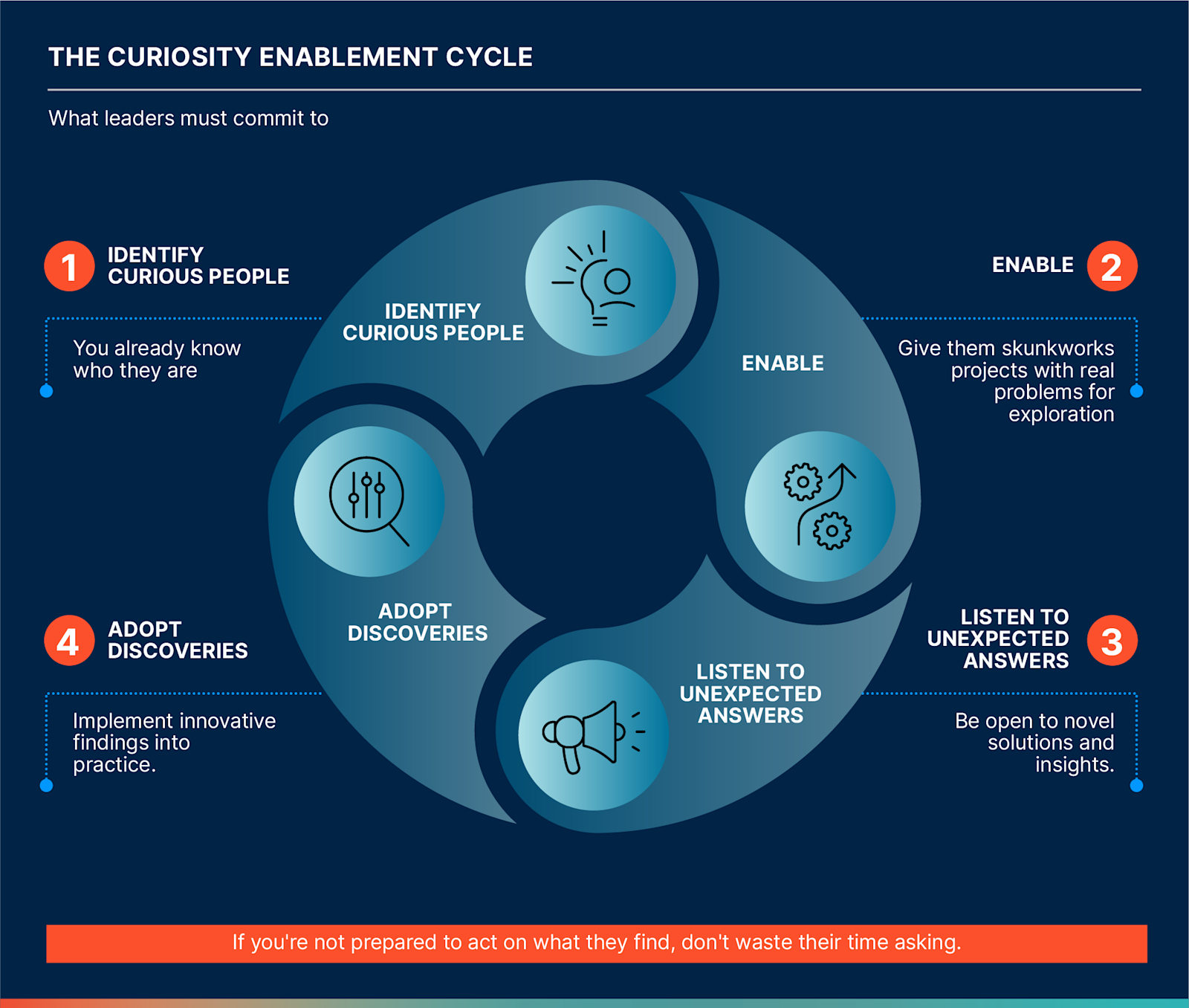
You have to be ready to listen. Curious people will come back with insights that challenge your assumptions. If you're not prepared to hear it, don't ask for it.
You have to be ready to change. The whole point of curiosity-driven exploration is to find better ways. If you're not prepared to change based on what they find, you're wasting everyone's time.
You have to be ready to adopt. Work with them knowing that change is coming. Go into it knowing that change will have risk. And go into it knowing you're going to adopt when you come out.
Start by scoping the skunkworks project in a small way: What's something you wish you could do that you couldn't before? Something that makes a difference but something you would actually adopt if you had a solution for it?
That's your starting point. Give it to your curious people. Get out of their way.
SIGNS YOU'RE IDENTIFYING CURIOSITY CORRECTLY
Use this diagnostic to evaluate whether you're finding the right people:
CURIOUS EMPLOYEES (Enable These):
Ask "why does this work?" not just "how do I use it?"
Experiment without being assigned to
Come back with "I tried something and here's what I found"
Question whether the output is actually good
Dig into failures to understand root cause
Connect AI capabilities to unsolved problems
Get frustrated by shallow answers
SURFACE-LEVEL USERS (Don't Confuse With Curious):
Follow tutorials step-by-step without deviation
Use AI frequently but don't understand it
Accept output without questioning quality
Wait to be trained on new capabilities
Blame the tool when results disappoint
Ask "what prompt should I use?" instead of understanding why
Satisfied with "it works" as an explanation
Volume of usage is not curiosity. Depth of understanding is.
WHAT I'D TELL MY FORMER SELF
If I had known then what I know now:
I would hire for curiosity over credentials every time. Credentials tell you what someone learned once. Curiosity tells you what they'll learn forever.
I would create safe spaces for experimentation. Curious people need room to fail. If failure is punished, curiosity is punished.
I would measure questions asked, not just answers delivered. The quality of someone's questions reveals the depth of their thinking.
I would stop assuming training creates capability. Training transfers knowledge. Curiosity creates understanding. They're not the same thing.
THE INDUSTRIAL REVOLUTION LESSON
This tool is coming regardless. You don't get a vote on whether AI transforms your industry. The only question is whether you're ready.
It's like walking into the Industrial Revolution, seeing a sewing machine, and going "nope, I'm a fan of my needle and thread."
I don't care if you're a fan of the old ways. This is the way we're doing things now. Figure out how to use the sewing machine or find another place to work.
There are thousands—tens of thousands—of people unemployed right now who have this attitude that AI is replacing them. And maybe it is replacing some of them. But it's not replacing everyone. It's replacing the people who refuse to adapt.
We have to change that attitude.
Your attitude has to be: I do things AI cannot do—like being curious, because humans are the only things that can be curious—and AI does things I both can't and don't want to do.
That's the partnership. That's how humans and AI work together. That's how you stay valuable.
THE EMPLOYEE WAKE-UP CALL
If you're an employee reading this, let me be direct.
The employees who treat GenAI as deceptively simple—who don't invest time in mastering it, who just prompt and pray—are making themselves replaceable.
It's not because AI is taking their jobs. It's because they're competing on the wrong dimension. If the only thing you bring is the ability to use a tool that everyone else can also use, you're a commodity. Commodities get replaced by cheaper commodities.
The employees who will matter are the ones who understand what AI can and can't do. Who know when to trust it and when to verify. Who can identify problems that AI can solve and problems that require human judgment. Who are curious enough to keep learning as the technology evolves.
Those employees aren't replaceable. They're force multipliers. They make everyone around them more effective. They're the ones who figure out how to actually get value from AI instead of just generating output.
Which one are you?
THE 2026 PREDICTION
Curiosity becomes THE differentiator in 2026.
The hype machine will cool. The easy wins will be exhausted. The companies that just deployed AI because it was trendy will face the reality that deployment isn't the same as value.
The organizations that thrive will be the ones that identified their curious people early. That enabled them to explore. That listened to what they found. That actually changed based on what they learned.
The organizations that struggle will be the ones that measured the wrong things. That counted certifications instead of comprehension. That rewarded usage instead of understanding. That optimized for metrics that had nothing to do with value.
Companies that enable curious workers with AI will beat companies that try to replace workers with AI. Every time. Without exception.
The curious will inherit the AI earth.
THE PLAYBOOK FOR ENABLING CURIOSITY
Five steps to build a curiosity-driven AI capability in your organization:
1. Identify your curious people now. You already know who they are. The ones who ask questions that make everyone think. The ones who experiment without permission. The ones who come back with "I tried something." Make a list. It's probably shorter than your AI training roster.
2. Create protected skunkworks time. Give them 10-20% of their time for exploration. No deliverables required. No approval process. Just space to be curious. If that feels risky, ask yourself what's riskier: giving curious people room to explore, or losing them to competitors who will.
3. Scope real problems worth solving. Not theoretical exercises. Real problems that matter. Things you would actually adopt if someone figured them out. The scope should be small enough to explore in weeks, but valuable enough to implement if it works.
4. Build feedback loops that actually listen. Regular report-outs where curious people share what they've learned. Leadership that asks questions instead of just receiving updates. A path from insight to implementation that doesn't require months of approval.
5. Reward understanding, not just usage. Promote the people who can explain why something works, not just that it works. Recognize the ones who identify when AI is wrong, not just the ones who generate the most output. Make comprehension the metric that matters.
KPIS TO MEASURE CURIOSITY IMPACT
| KPI | Target | What It Measures |
|---|---|---|
| Experiments Initiated Without Assignment | 2+ per quarter per curious employee | Self-directed exploration happening |
| Problems Identified Before Asked | 1+ per quarter | Proactive problem-finding |
| Adoption Rate from Skunkworks | 30%+ lead to implementation | Whether you're actually listening |
| Explanation Depth Score | 3 levels deep on "why" | Comprehension versus usage |
| Question Quality Rating | Increasing complexity over time | Growth in understanding |
If your AI metrics are all about output volume and prompt counts, you're measuring the wrong things.
INTERNAL CONVERSATIONS
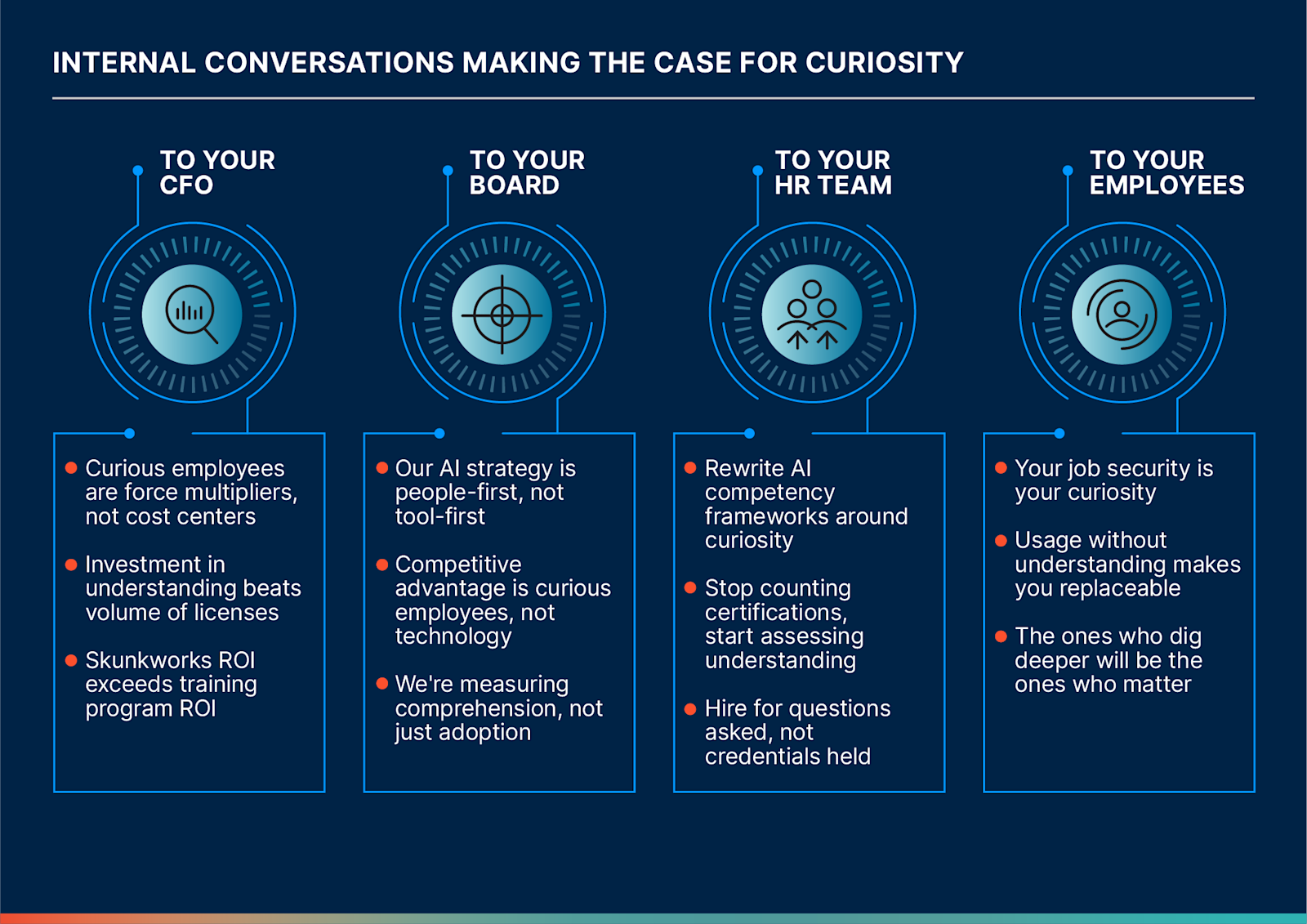
What to tell your CFO when they question skunkworks investment:
"Curious employees are force multipliers, not cost centers. One curious person who figures something out is worth ten who just use tools."
"The ROI on enabling understanding exceeds the ROI on buying more licenses. We have enough tools. We need people who can make them work."
"Our skunkworks projects have a higher implementation rate than our formal AI initiatives. We're getting more value from curiosity than from process."
What to tell your Board when they ask about AI workforce strategy:
"Our strategy is people-first, not tool-first. We're building capability through curious employees, not through technology purchases."
"Our competitive advantage isn't the AI tools—everyone has access to those. Our advantage is the people who know how to make them work."
"We measure comprehension, not just adoption. Usage metrics are vanity metrics. Understanding metrics predict actual value."
What to tell your HR Team when they're building AI competency frameworks:
"Rewrite the frameworks around curiosity. The current metrics reward the wrong behaviors."
"Stop counting certifications and start assessing understanding. Ask people to explain why something works, not just how to use it."
"In hiring, weight questions asked over credentials held. The best predictor of AI success is intellectual curiosity, not prior AI experience."
What to tell your Employees when they ask what matters in an AI world:
"Your job security is your curiosity. The people who dig deeper will be the ones who matter."
"Usage without understanding makes you replaceable. If all you can do is prompt, you're competing with everyone else who can prompt."
"AI does things you can't and don't want to do. You do things AI can't—like being curious. Lean into that."
TO LEADERS
Stop measuring AI competency with certifications. Start identifying who asks the best questions.
The people who will drive AI value for your organization aren't the ones with the most badges. They're the ones who can't stop asking why. They're the ones who experiment without being told to. They're the ones who come back with insights that surprise you.
Find them. Enable them. Listen to them. Adopt what they discover.
Or watch your competitors do it first.
TO HR DEPARTMENTS
Your AI readiness assessments are worthless if they don't measure curiosity.
I've seen the competency frameworks. They measure tool proficiency, prompt construction, output evaluation. They treat AI like any other software to be learned and certified.
AI isn't like other software. It's a partnership that rewards depth of understanding in a way that traditional tools never did. The superficial user and the deep user get radically different results from the same tool.
Your assessments need to distinguish between them. If they can't, rewrite them.
TO EMPLOYEES
Figure out how to use the sewing machine or find another place to work.
That sounds harsh, but it's reality. This technology is coming whether you embrace it or not. The question isn't whether AI will transform your work—it's whether you'll be the one doing transformed work or the one being replaced.
The employees who will thrive are the curious ones. The ones who dig in. The ones who understand, not just use. The ones who can do what AI can't—think creatively, ask unexpected questions, be genuinely curious about problems.
Be that employee. Your career depends on it.
A NOTE ON ANALYST CULTURE
Most analyst coverage of AI workforce transformation focuses on tools and training.
They produce reports on which AI platforms to adopt. They create frameworks for AI training programs. They measure readiness by technology deployment.
They miss the point entirely.
The technology is a commodity. Everyone has access to the same tools. The training is table stakes. Everyone can run the same programs.
The differentiator is human—the curious people who know how to make technology actually work. That's not something you can buy or deploy or train into existence. It's something you identify, enable, and get out of the way of.
GigaOm focuses on the human factors that determine AI success. Because that's where the actual competitive advantage lives.
ONE-PAGE SUMMARY
THE PREDICTION: Curiosity becomes THE differentiator in 2026. Companies that enable curious workers with AI will beat companies that try to replace workers with AI. Every time. Without exception.
WHY CURIOSITY MATTERS:
Machines aren't curious—only humans can ask "why" and "what if"
Usage without understanding makes employees replaceable
The gap between surface users and deep users is the competitive gap
SIGNS OF GENUINE CURIOSITY:
Asks "why does this work?" not just "how do I use it?"
Experiments without being assigned to
Questions whether output is actually good
Digs into failures to understand root cause
THE PLAYBOOK:
Identify your curious people now—you already know who they are
Create protected skunkworks time (10-20% for exploration)
Scope real problems worth solving (small enough to explore, valuable enough to implement)
Build feedback loops that actually listen
Reward understanding, not just usage
KPIS TO TRACK:
Experiments Initiated Without Assignment (target: 2+ per quarter)
Problems Identified Before Asked (target: 1+ per quarter)
Adoption Rate from Skunkworks (target: 30%+)
Explanation Depth Score (target: 3 levels deep)
Question Quality Rating (target: increasing complexity)
THE BOTTOM LINE: The technology is a commodity. Everyone has the same tools. The differentiator is the curious people who know how to make them work. Find them. Enable them. Get out of their way.
Howard is CEO of GigaOm, bringing 38 years in IT and 20 years at the C-level as CISO, CIO, and CTO to technology analysis. His "Inside Out" series combines practitioner experience with analyst perspective to challenge industry narratives and provide actionable guidance for technology leaders.